A Market of Opportunity, Not Momentum

London’s housing market is entering a more balanced phase, with increased stock, greater buyer choice and softer pricing in some areas creating opportunities for those prepared to act strategically rather than rely on rising values.
After several years defined by fierce competition and limited stock, London's housing market is becoming more balanced. Higher borrowing costs, increased housing stock and greater buyer choice are reshaping the market, creating conditions that feel markedly different from the post-pandemic boom.
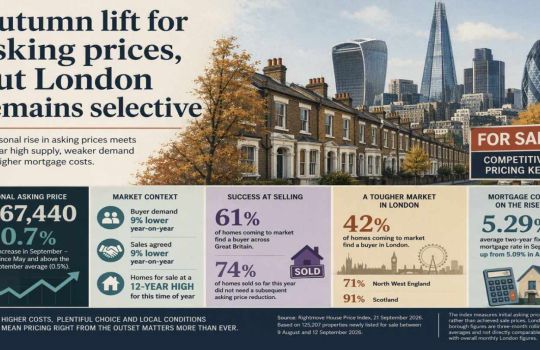
According to the latest Rightmove House Price Index, the number of homes available for sale is at its highest level for twelve years. Buyer demand is running 8% below the same period last year, while agreed sales are down 7%. New listings are also 3% higher year-on-year, providing purchasers with significantly more choice than they have enjoyed in recent years.
Affordability
Affordability remains the market's defining challenge. Rightmove reports that the average two-year fixed mortgage rate stands at 5.51%, compared with 4.25% earlier in the year. According to its analysis, this has added more than £200 per month to the cost of a typical new mortgage, reducing borrowing power and encouraging buyers to scrutinise value more carefully.
Sellers
For sellers, realistic pricing has become increasingly important. While desirable family homes continue to attract interest, buyers are becoming more selective and price-conscious. With more stock available, properties launched at sensible asking prices are often better positioned to generate early interest than those brought to market at ambitious levels.
| Feature - scroll to continue with content... |


| continue reading article... |
Buyers
For buyers, conditions are arguably the most favourable for several years. Greater choice, less competition and softer pricing in some parts of the capital have created more scope for negotiation than many purchasers have experienced since before the pandemic.
This shift is particularly evident in the flats market. Rightmove reports that average asking prices for flats have fallen by 1.7% over the past year, while houses have recorded a modest increase of 0.1%. Service charges, leasehold considerations and wider ownership costs continue to influence buyer behaviour, contributing to a widening performance gap between different property types.
Prime
Even prime London locations are not immune to changing market dynamics. In Kensington and Chelsea, average asking prices remain among the highest in the country, yet borough-level figures show values below their level of a year ago. In Merton, home to Wimbledon and several of south-west London's most sought-after family neighbourhoods, asking prices have also moved lower over the same period.
Investors
For investors, the picture is more nuanced. Softer pricing may create opportunities, particularly in the apartment sector, but elevated borrowing costs continue to influence returns. Rightmove also notes that agents are seeing more flats come to market, including some former rental properties, increasing choice for prospective buyers.
| Feature - scroll to continue with content... |


| continue reading article... |
Implications
The implications extend beyond the sales market. Market conditions suggest that some households may remain in rented accommodation for longer as affordability challenges delay a move into home ownership. If that trend persists while rental supply remains constrained, demand for rented homes is likely to remain resilient.
Recalibration
The result is a market that feels neither overheated nor distressed. Instead, London appears to be undergoing a period of recalibration. Buyers have regained a degree of leverage, sellers face greater competition, and investors are becoming increasingly selective.
For buyers, that means more choice. For sellers, it means a greater need for pricing realism. For investors, it means focusing more closely on individual opportunities rather than relying on broad market momentum. In each case, success is becoming less dependent on rising prices and more reliant on informed decision-making.
Sources & Further Reading
- Rightmove House Price Index (16 November 2026) - Primary source for housing stock, buyer demand, sales activity, mortgage-rate data and London borough asking-price trends.
- UK House Price Index Summary: September 2026 (HM Land Registry / Office for National Statistics, published 18 November 2026)
- UK House Price Index England: September 2026 (HM Land Registry / Office for National Statistics, published 18 November 2026)
- Private Rent and House Prices, UK (Office for National Statistics)
This article is for informational purposes. Always seek professional advice before making any property or financial decisions. The views expressed in this article are opinion-based commentary intended to explore potential market outcomes. Housing market performance is influenced by a wide range of factors including interest rates, mortgage availability, economic growth, employment levels, taxation, housing supply, and consumer confidence. Actual market developments may differ from the scenarios discussed. Always seek professional advice before making any property or financial decisions.