London Property Market Reconfiguration?
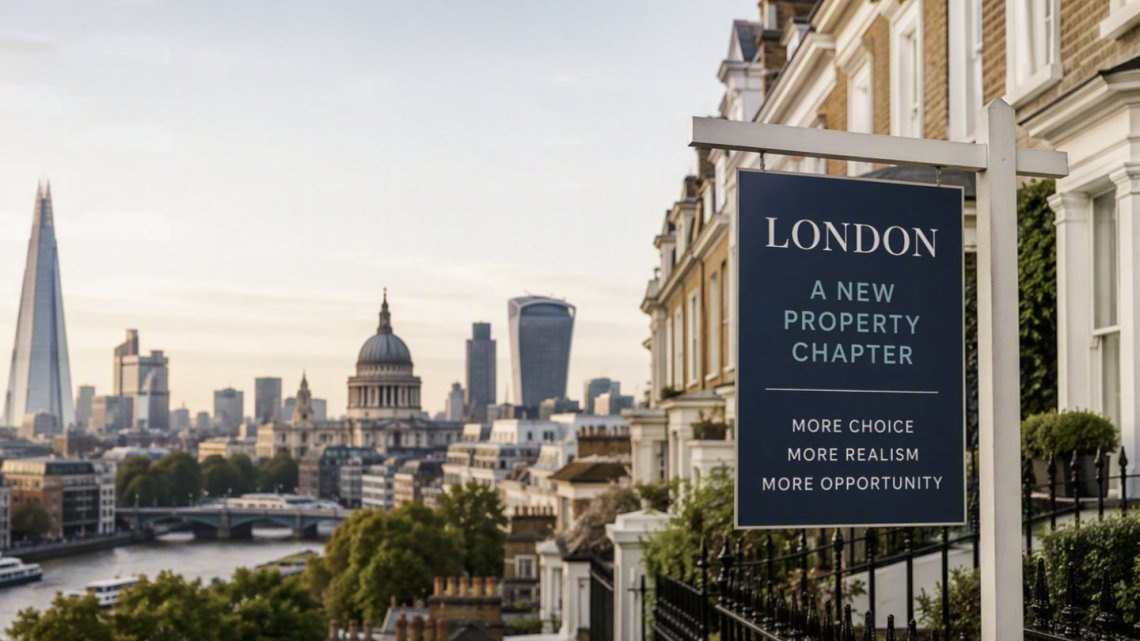
As summer draws to a close, the latest data suggests the UK housing market will enter autumn in a very different mood. Sellers are becoming more pragmatic, buyers remain cautious, and nowhere are the contrasts more visible than in London.
The traditional August slowdown is nothing new. Estate agents expect holiday distractions, fewer viewings and a softer market while much of the country focuses on summer rather than moving home. Yet this year’s slowdown feels more significant.
According to the latest Rightmove House Price Index, the average asking price of a newly listed home fell by 2.0% during the month, the largest August drop since 2018, taking the national average asking price to £364,999. Prices are now 1.0% lower than a year ago, marking the biggest annual decline since December 2023.
At first glance, the figures suggest a cooling market. Look more closely, however, and a more nuanced picture emerges. Rather than a nationwide downturn, Britain appears to be experiencing a growing regional divide, with London and much of southern England moving in a different direction from many northern markets.
A Market of Contrasts
National averages can often disguise what is really happening on the ground, and Rightmove argues that this is increasingly the case.
Across northern England, asking prices are 1.5% higher than a year ago, while Scotland continues to record annual growth. By contrast, prices across southern England are down by 1.8%, with London seeing the sharpest fall of any region at 3.1% year-on-year.
This divergence reflects more than simple supply and demand. Northern cities and regional centres continue to benefit from comparatively affordable housing, stronger value propositions for buyers and, in many cases, ongoing investment and regeneration.
London, meanwhile, faces a different set of pressures.
The Capital’s Affordability Challenge
For decades, London has operated according to its own housing-market rules. This year, however, even the capital’s resilience is being tested.
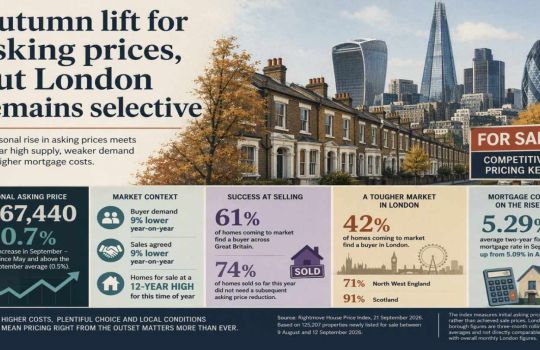
Rightmove reports that the number of homes available for sale in London is at its highest level for sixteen years, creating intense competition between sellers. Buyers have more choice than they have had for over a decade, giving them greater negotiating power and making pricing strategy increasingly important.
Affordability remains a central challenge. Rightmove notes that the average London home now costs around 17 times the national average annual wage and remains substantially more expensive than any other UK region. Elevated mortgage rates add further pressure, while higher stamp duty liabilities and the long-standing £450,000 Lifetime ISA cap continue to affect many first-time buyers in the capital.
The result is not necessarily a market in decline, but one that has become far more price-sensitive. The capital's large flat market, in particular, faces additional scrutiny from buyers increasingly focused on service charges, lease terms and the wider costs of ownership. Astute sellers are, however, revising their expectations to realise sales.
| Feature - scroll to continue with content... |


| continue reading article... |
London’s Borough Story
Even within London, the picture is far from uniform.
Some boroughs continue to show annual growth. Haringey recorded annual asking-price growth of 5.7%, while Bromley, Redbridge and Barking & Dagenham also remained in positive territory.
Elsewhere, values have softened more noticeably. Wandsworth saw annual asking prices down by 5.8%, Lambeth by 5.7%, while Kensington & Chelsea recorded a 3.8% annual decline despite remaining London's most expensive borough with an average asking price exceeding £1.55 million.
For buyers, these conditions may present opportunities that have been rare in recent years. Greater choice, more realistic pricing and less competitive bidding environments can create room for negotiation, particularly in higher-value markets.
Signs of Renewed Momentum
Despite the softer pricing backdrop, there are reasons for cautious optimism.
Rightmove reports a 5% increase in buyer demand since Andy Burnham became Prime Minister on 20 July, describing it as a "mini bounce" in activity. While overall demand remains around 10% lower than last year, the improvement contrasts with the seasonal slowdown that would normally be expected at this time of year.
The housing market remains heavily influenced by confidence. Political certainty, even if temporary, can encourage buyers who have been waiting on the sidelines to resume their search.
At the same time, many sellers appear to be responding realistically to current conditions. Rather than chasing peak-market pricing, a growing number are entering the market with more competitive asking prices from the outset. Rightmove suggests that this approach significantly improves the likelihood of securing a buyer and progressing to completion.
| Feature - scroll to continue with content... |


| continue reading article... |
The Mortgage Question
The biggest unknown remains borrowing costs.
The average two-year fixed mortgage rate has risen to 5.09%, up from 4.95% a month earlier, reflecting continuing geopolitical uncertainty and wider financial-market volatility.
Yet there are tentative signs of encouragement. Rightmove's mortgage experts note that lenders remain highly competitive and have already begun edging rates down in some areas. If mortgage pricing eases further during the autumn, buyer confidence could strengthen, particularly among first-time purchasers and movers who have delayed decisions during the summer.
A More Balanced Market
The housing market of 2026 is proving difficult to categorise. It is neither booming nor collapsing. Instead, it appears to be undergoing a gradual rebalancing.
For London, that adjustment is perhaps more visible than anywhere else. After years in which demand frequently outpaced supply, buyers now have greater choice and stronger negotiating positions. Sellers, meanwhile, are discovering that realistic pricing matters more than ever.
Beyond the capital, much of northern England and Scotland continue to demonstrate resilience, highlighting the increasingly local nature of Britain's housing market.
Rightmove has consequently revised its forecast for national asking-price growth this year, now expecting overall annual movement to fall somewhere between 0% and -2%.
That may sound subdued, but it also suggests stability rather than turmoil. And as autumn approaches, the market's fortunes may depend less on headline house-price figures and more on confidence, mortgage rates and whether buyers feel ready to make their move.
Source: Rightmove House Price Index, published 17 August 2026. All statistics and market data attributed to Rightmove unless otherwise stated.
Editorial Note: This article is for informational purposes. Always seek professional advice before making any property or financial decisions. Some of the views expressed in this article are opinion-based commentary intended to explore potential market outcomes. Housing market performance is influenced by a wide range of factors including interest rates, mortgage availability, economic growth, employment levels, taxation, housing supply, and consumer confidence. Actual market developments may differ from the scenarios discussed. Always seek professional advice before making any property or financial decisions.