London Rents Hit Record High as Supply Tightens
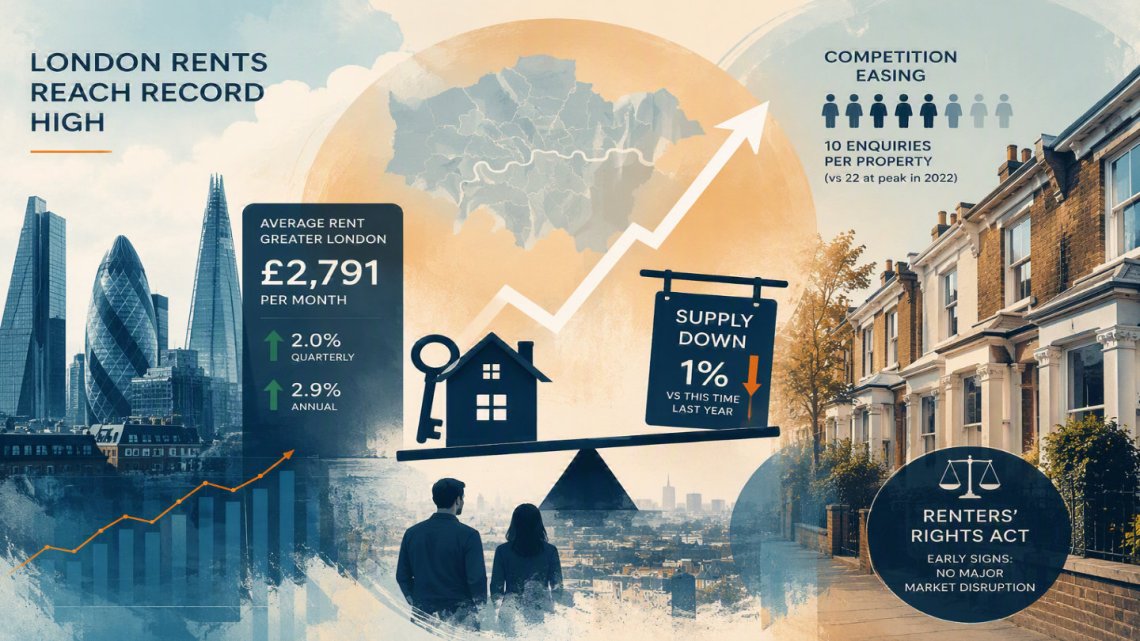
As rents in the capital reach yet another record, the latest data suggests London’s lettings market is entering a more nuanced phase : less frantic than the post-pandemic scramble, but still defined by chronic undersupply and persistent affordability pressures.
For much of the past five years, London’s rental market has lurched between extremes. There was the pandemic exodus from city centres, the rapid rebound that followed, and then the extraordinary supply squeeze that left prospective tenants competing with dozens of rivals for a single flat.
Now, according to the latest Rightmove Rental Trends Tracker, the market appears to be settling into something closer to a steady rhythm. Yet if the data points to greater balance, it offers little comfort for renters hoping that balance might translate into lower costs. London rents have reached a fresh record high, while the pool of available homes has started to shrink once again.
The average advertised rent across Greater London now stands at £2,791 per calendar month, up 2.0 per cent on the previous quarter and 2.9 per cent year-on-year. More strikingly, the quarterly increase is the largest recorded in the capital since 2023.
At first glance, these are not the dramatic double-digit jumps that characterised the rental boom of 2022 and 2023. Yet they reinforce an uncomfortable reality for London tenants: rents are still moving in one direction, even if the pace is more measured than before.
A Tale of Two Londons
The headline figures conceal an important geographical distinction. It is Inner London that is driving the latest surge.
Average advertised rents in Inner London have climbed to £3,299 per month, a quarterly increase of 2.2 per cent and annual growth of 3.4 per cent. Outer London, by contrast, recorded a more modest quarterly rise of 1.8 per cent, taking average rents to £2,418 per month.
That divergence suggests the capital's core districts continue to attract renewed demand from renters prioritising proximity to employment centres, transport links and urban amenities. The return-to-office debate may be less intense than it was a few years ago, but the economics of commuting still exert a powerful influence on housing decisions.
For many would-be tenants, particularly younger professionals, the calculation increasingly revolves around whether the savings achieved by moving further out can justify longer travel times and higher transport costs. The latest figures imply a growing number are once again choosing convenience over distance.
| Feature - scroll to continue with content... |


| continue reading article... |
The Supply Story Matters More Than Demand
Perhaps the most significant finding in the report is not the record rent itself but what lies behind it.
For the first time since 2022, the number of available rental homes nationally has fallen below the level recorded a year earlier. Overall rental stock is now 1 per cent lower than at the same point in 2025. Importantly, the decline appears to stem less from properties being snapped up at greater speed and more from fewer new homes being listed in the first place.
That distinction matters.
The rental market's fiercest years were characterised by overwhelming tenant demand colliding with historically low stock levels. Today's environment looks different. Demand remains resilient, but supply growth has stalled. In other words, rents are rising not because the market is overheating, but because the structural shortage of rental homes has never truly been resolved.
London exemplifies this dynamic. The report notes that the capital has experienced the largest drop in available rental supply among UK regions while simultaneously recording its strongest quarterly rental increase in several years.
The result is a market that feels calmer than before, yet remains fundamentally constrained.
Competition Has Eased - Relatively Speaking
There is, however, evidence that conditions for renters are less punishing than they were during the peak of the post-pandemic frenzy.
Nationally, the average rental property now receives ten enquiries. That remains high by historical standards but is below the eleven recorded a year ago and dramatically lower than the twenty-two enquiries per property seen during the height of competition in 2022. Pre-pandemic, the average was just five.
London is, interestingly, the most balanced market in the country according to Rightmove's measures, with an average of eight enquiries per rental property. That compares favourably with regions such as the North West, where the average property attracts fourteen enquiries.
This does not necessarily mean London renters have it easier. Rather, it reflects the city's exceptionally high pricing, which naturally limits the pool of prospective tenants able to compete for each home.
Affordability is emerging as the market's new moderating force. With wage growth easing and household budgets remaining under pressure, tenants are becoming increasingly selective about what they are willing, or able, to pay.
| Feature - scroll to continue with content... |


| continue reading article... |
A New Legislative Backdrop
The second quarter of 2026 is also notable because it is the first period analysed after the introduction of the Renters' Rights Act in May.
It remains far too early to draw definitive conclusions about the legislation's impact. Yet the report suggests that, thus far, supply, demand and pricing patterns appear broadly consistent with seasonal norms rather than exhibiting any dramatic behavioural shift among landlords or tenants.
That observation will be watched closely across the sector. Much of the debate surrounding rental reform has centred on whether tighter regulation could discourage landlords from remaining in the market. For now, at least, the evidence points towards continuity rather than disruption.
What Happens Next?
The outlook for London's rental market is unlikely to be defined by a sudden collapse in rents or a return to the extraordinary inflation seen earlier this decade.
Instead, the city appears to be entering a phase of slower but persistent growth. Rental demand remains robust. Supply is no longer expanding. Mortgage costs for landlords remain elevated, with average two-year fixed buy-to-let rates at 5.55 per cent.
In many ways, that combination creates the conditions for what might be called a "new normal": fewer bidding wars, more measured tenant behaviour and a less manic marketplace overall - but with rents continuing to edge upwards because there are still not enough homes available.
For Londoners, that may be the most telling message in the latest figures. The market has become calmer. It has not become cheaper. And until the capital addresses the long-standing imbalance between housing demand and rental supply, record rents may continue to be broken even in a more stable market.
Editorial Note: This article is for informational purposes. Always seek professional advice before making any property or financial decisions. The views expressed in this article are opinion-based commentary intended to explore potential market outcomes. Housing market performance is influenced by a wide range of factors including interest rates, mortgage availability, economic growth, employment levels, taxation, housing supply, and consumer confidence. Actual market developments may differ from the scenarios discussed. Always seek professional advice before making any property or financial decisions.