Global Conflict And the London Property Market

Whether a quiet street in Belgravia or a glass tower along the Thames, London property often feels oddly insulated from global volatility. Yet the capital’s housing market has long reflected global political and economic forces. When uncertainty rises - whether through war, sanctions or energy shocks - the effects tend to surface in subtle but significant ways.
Today’s conflicts - from the war in Ukraine to the rapidly escalating U.S.-Israeli war with Iran - are once again prompting investors, developers and policymakers to ask a familiar question: when the world becomes unstable, does London benefit, or does it suffer?
As ever, the reality is nuanced.
A new geopolitical cycle
The latest shock stems from the full-scale conflict involving Iran, which has triggered exceptional volatility in global energy markets. Oil prices have repeatedly surged above $100 a barrel as attacks on tankers and infrastructure disrupt shipping through the Strait of Hormuz, a chokepoint that normally carries a large share of global oil exports.
These disruptions have raised renewed concerns about inflation across Europe, including the UK.
British policymakers have warned that sustained instability in energy markets could delay interest rate cuts, and lenders have already nudged mortgage rates higher as wholesale energy costs rise. Since housing demand is closely tied to borrowing costs, higher rates continue to pull on affordability - particularly for first-time buyers.
Developers, too, are turning cautious. Several major house-builders have signalled that the ongoing geopolitical backdrop could weigh on buyer confidence and slow activity, even where underlying supply remains largely unchanged.
In short, the first effects of conflict tend to be financial rather than physical - felt through inflation and tighter monetary conditions.
London’s paradox: instability can attract money
Yet global volatility can also drive capital towards London. In times of upheaval, investors often gravitate to jurisdictions with strong legal protections, stable institutions and deep markets.
This pattern has repeated across decades. After the collapse of the Soviet Union, Russian capital flowed into prime central London. Similar trends have long been visible among Middle Eastern and Asian investors during periods of regional instability.
Current events may reinforce this dynamic. Iran’s newly appointed Supreme Leader, Mojtaba Khamenei, has vowed to continue blocking the Strait of Hormuz and maintain military pressure across the region, signalling that the present conflict may be prolonged.
Periods of extended tension often encourage high-net-worth individuals, especially in affected regions, to diversify assets abroad - and London remains a leading destination.
Investigations over recent years have documented property interests in London linked to figures associated with Iran’s political elite, illustrating how deeply global capital flows are embedded in the city’s real-estate ecosystem.
| Feature - scroll to continue with content... |


| continue reading article... |
The Ukraine precedent
The war in Ukraine provides a useful reference point. Following Russia’s 2022 invasion, sweeping Western sanctions sharply reduced Russian activity in London’s prime districts. Areas such as Knightsbridge and Belgravia saw long-established buyer groups vanish almost overnight.
Yet the market adapted. Buyers from the Middle East, the United States and Asia filled the gap, demonstrating that London’s appeal as a stable, rules-based destination tends to persist even when the geopolitical landscape changes.
What shifts is not the presence of global demand - but its composition.
The inflation and interest rate channel
For most Londoners, geopolitics influences the housing market via energy prices and inflation rather than international capital flows.
Conflicts that disrupt oil and gas supply chains drive up wholesale energy costs. The current war has created the largest supply disruption seen in decades, with multiple tanker attacks and active obstruction of shipping.
Analysts warn that higher energy costs could continue feeding inflation, increasing the likelihood that interest rates remain elevated for longer.
Persistently higher mortgage costs squeeze first-time buyers, slow transactions and keep many households on the sidelines. In practice, the impact of geopolitical conflict is often felt not in headlines, but in monthly repayment calculations.
Construction costs and supply
Global turmoil also affects the supply side of the market. Rising energy prices push up the cost of construction materials such as steel, glass and cement. At the same time, attacks across the Gulf - including on facilities in the UAE - have increased shipping risk and raised insurance and freight costs.
These pressures make development more expensive and can slow new building starts. In a city already struggling with structural undersupply, sustained geopolitical volatility risks tightening availability further, supporting prices even as affordability deteriorates.
| Feature - scroll to continue with content... |


| continue reading article... |
Capital flight versus affordability
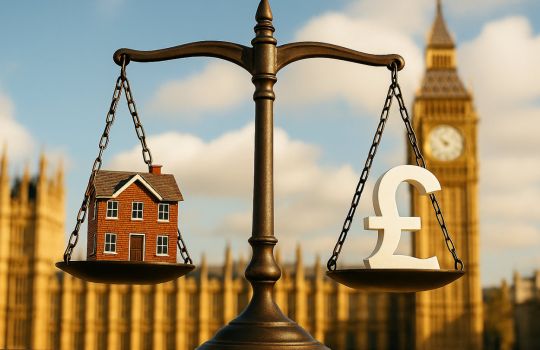
Taken together, these forces create a pronounced duality.
At the top end of the market, geopolitical uncertainty can attract global wealth seeking stability. Prime central London homes may see renewed interest from investors looking to shield capital from regional turmoil.
Lower down the ladder, however, the same instability - via higher borrowing costs and inflation - can dampen domestic demand.
In effect, conflict can widen the gap between the global and local tiers of London’s housing market.
A city shaped by the world
London has always been unusually sensitive to global forces. Its property market sits at the intersection of international finance, migration, diplomacy and geopolitics.
When oil prices spike due to tanker attacks in the Gulf, when new leadership in Iran vows to keep key shipping routes closed, or when sanctions reshape flows of global wealth, these pressures eventually appear in London’s real estate data, transaction patterns and development pipelines.
The city’s homes are never just places to live; they are also a barometer of global power and uncertainty. And if history is any guide, the next geopolitical shock - whatever form it takes - will again leave its imprint on London’s streets, prices and skylines.
This article is for informational purposes. Always seek professional advice before making any property and/or financial decisions.